When is a constipated baby a reason to call the pediatrician?

Call your pediatrician about constipation if your baby is under 2 months old, if a breastfed baby under 1 month isn’t pooping much, or if there’s blood from the bottom, a swollen tummy with vomiting, or tummy or bottom pain that lasts more than an hour after you’ve tried home care. Green vomit, or a baby who looks very unwell, needs emergency care straight away. Otherwise, going a few days without a poo is often normal, especially for breastfed babies over a month old. What counts is whether the poo is hard and painful to pass, not just how long it has been. If home care hasn’t helped after a few days, call during office hours.
What counts as constipation in a baby?
Constipation is about the poo itself as much as the calendar. The NHS lists these signs in babies: pooing fewer than 3 times in a week; dry, hard, lumpy or pellet-like poos; unusually smelly wind and poo; being less hungry than usual; a firm tummy; and low energy or grumpiness. Its children’s page adds poos that are large and hard, straining or pain when pooing, and a little bleeding during or after a poo because the poo is large and hard.
The American Academy of Pediatrics (AAP) asks parents to look for a similar set of signs. Is your baby very fussy? Spitting up more than usual? Having far more or far fewer poos than before? Are the stools unusually hard, or is there blood linked to hard stools? Is your baby straining for more than 10 minutes without passing anything? The AAP says these signs can all suggest actual constipation.
A soft poo after a gap of several days is a different thing from a hard, painful one.
Is it normal for my baby to go days without pooping?
It depends on age and feeding.
- Breastfed babies under 1 month: here a gap is a feeding question. The AAP says that in the first month, pooing less than once a day might mean a newborn isn’t eating enough. The NHS says a breastfed baby aged 4 days to 6 weeks should pass at least 2 yellow poos a day, and that if your baby hasn’t pooed in 24 to 48 hours you should speak to your midwife or health visitor, because it may mean they aren’t getting enough milk.
- Breastfed babies over 1 month: much longer gaps can be normal. The AAP says older breastfed infants may go several days or even a week between poos. Its symptom checker says poos every 4 to 7 days can be normal if they’re soft, large and pain-free.
- Formula-fed babies: the AAP says a formula-fed baby usually poos at least once most days, and may go a day or two between poos.
Colour is a separate question. Our guide to what newborn poop colors mean covers the white, red and black poos that always need a call.
Is straining and grunting a sign of constipation?
Usually not on its own. The AAP says babies normally work hard to have a poo, and straining isn’t necessarily alarming, even when a baby cries or goes red in the face. Its symptom checker explains that young babies are still learning to relax their bottom while they push. The sign it gives for normal straining: your baby keeps passing normal-size poos every day.
Straining becomes a concern when it comes with hard stools, or when it goes on for more than 10 minutes without success, which is one of the AAP’s signs above.
What can I try at home?
These are the first steps the NHS and the AAP describe. The AAP’s checker says to contact the doctor about constipation in any baby under 2 months, so for a young baby, call before trying anything beyond extra feeds.
- Breastfed babies not yet on solids: offer plenty of breastfeeds (NHS).
- Formula-fed babies: the NHS says they can have extra drinks of water between formula feeds, and that this must be cooled boiled water for babies under 6 months.
- Movement and massage: the NHS suggests lying your baby on their back and gently moving their legs as if riding a bicycle, or a gentle tummy massage if they’re happy lying down.
- Babies on solids: the NHS suggests fibre-rich foods such as apples, pears and prunes, and the AAP calls prunes “that old standby”.
- Fruit juice: the AAP says small amounts of apple or pear juice may help babies aged 1 month and older, because the sugars draw fluid into the gut and loosen the stool. Ask your pediatrician how much to give before you start.
Laxatives, suppositories and enemas are for your doctor to decide on. The NHS says a GP may prescribe a laxative, and the AAP’s symptom checker lists needing a suppository or enema, or using stool softeners without talking to the doctor, as reasons to call.
How can I tell if it’s getting better or worse?
Write it down. A note of when each dirty diaper happened and what the poo was like, hard, pellet-like, soft or bloody, turns “I think it’s been a while” into something you can tell your pediatrician. If two of you change diapers, keep the note somewhere you both can see. Our posts on how many wet diapers a newborn should have and preventing and treating diaper rash cover the rest of what diapers can tell you.
When should I call my pediatrician?
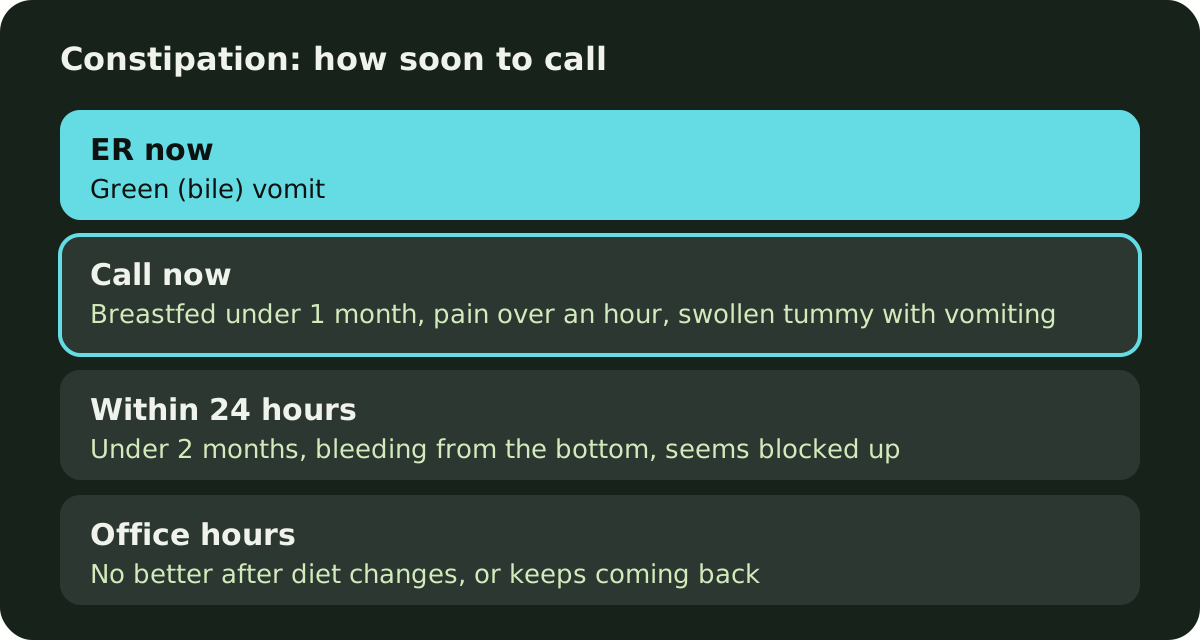
The AAP’s constipation symptom checker sorts the signs by how quickly to act. The NHS is simpler: if you think your child may be constipated, take them to a GP, and get help early, because constipation that goes on longer is harder to sort out.
Go to the emergency room now if your baby:
- is vomiting bile, which is green (yellow stomach juice is different)
Call your pediatrician now if your baby:
- is under 1 month old and breastfed, and you’re worried about constipation
- is under 12 months old and has recently developed a weak suck or weak muscles
- has had tummy pain, including crying, for more than an hour after you’ve tried home care
- has had bottom pain, including straining, for more than an hour after you’ve tried home care
- has vomited 2 or more times and their tummy looks more swollen than usual
- looks or acts very sick, or you feel it can’t wait
Call within 24 hours if your baby:
- is under 2 months old, unless it’s the normal straining and grunting described above
- is bleeding from the bottom
- seems blocked up
- was given a suppository or enema that didn’t work
Call during office hours if:
- poos are still infrequent after diet changes (unless your baby is breastfed, over 1 month and the poos aren’t painful)
- poos have been painful 3 or more times after diet changes
- your baby needed a suppository or enema to poo, or you’re using a stool softener you haven’t discussed with your doctor
- constipation keeps coming back, or you have other questions
Trust your instincts too. If your baby seems unwell in a way that worries you, call, whatever the diaper says.
Sources
This article is for general education and is not medical advice. Talk to your pediatrician about your baby's health.