What do newborn poop colors mean?

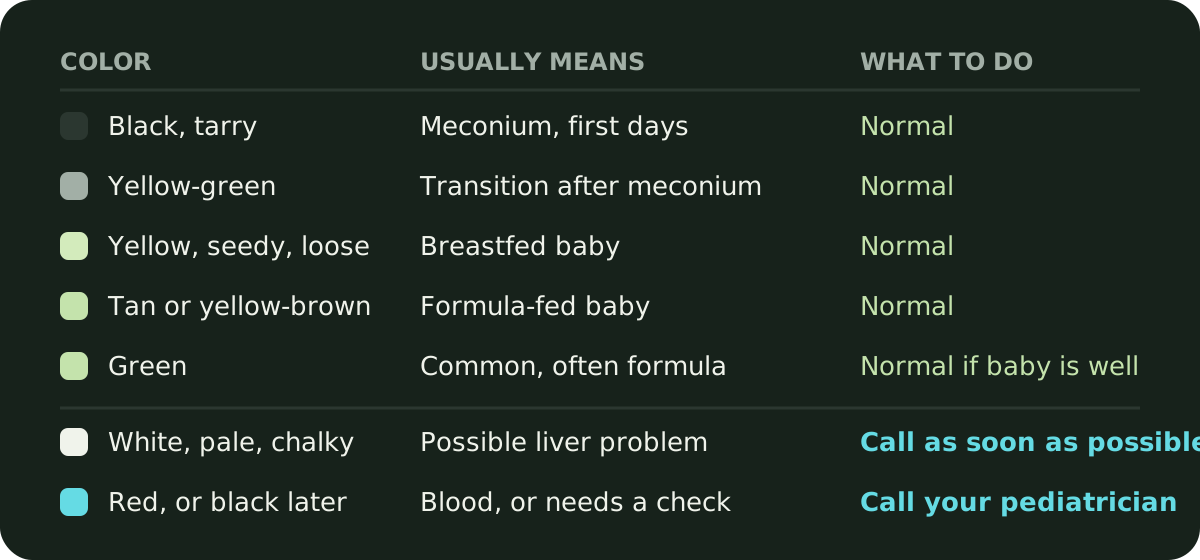
Newborn poop changes color in a predictable order. For the first few days it is black or dark green and sticky (meconium), then it turns yellow-green, and by the end of the first week it settles into mustard yellow and seedy for breastfed babies or tan to yellow-brown and firmer for formula-fed babies. Green shades along the way are common and usually nothing to worry about. Three colors do need a call to your pediatrician: white or pale, red, and black once the meconium days are over.
What is meconium and how long does it last?
Your baby’s first poop is meconium. The American Academy of Pediatrics (AAP) describes it as a thick black or dark green substance that filled your baby’s intestines before birth. The NHS says it is sticky and greenish-black, and that it is passed during or after birth, or within the first 48 hours. It looks alarming the first time you open the diaper, and it is exactly what should be there.
The AAP says meconium is what you will see for the first few days. Once your baby has passed enough of it, the color shifts.
What are transitional stools?
In between the meconium and the “settled” poop of the second week, you’ll see a change in both color and texture. The AAP says that once the tarry meconium is cleared, stools move to a yellow-green color. The NHS says that after a few days the poop changes to a yellow or mustard color. The in-between stage is a good sign: milk is moving through.
If you’re counting diapers in this first week to check feeding is going well, our post on how many wet diapers a newborn should have covers both wet and dirty diapers day by day.
What does breastfed baby poop look like?
The AAP describes breastfed stools as yellow liquid mixed with small particles that remind many parents of little seeds. Its color page calls the typical shade “mustardy yellow”. Until solid foods start, the AAP says breastfed stools can range from very soft to loose and runny, and that is normal rather than diarrhea.
The NHS also notes that breastfed babies’ poop is runny and doesn’t smell much, which surprises a lot of parents.
What does formula-fed baby poop look like?
The AAP says formula-fed babies usually have tan or yellow stools, firmer than a breastfed baby’s but no firmer than soft clay. Its color page describes a yellow-tan shade with hints of green. The NHS describes formula-fed poop as firmer, darker brown and smellier than breastfed poop.
If you switch from breast milk to formula, the NHS says the poop will usually become darker and firmer. That shift is expected.
Is green poop normal?
Usually, yes. The AAP says green stools are not unusual and should not cause alarm. Its color guide goes further: every shade of yellow, brown and even green that follows meconium is considered acceptable. The NHS notes that some infant formulas turn poop dark green.
A couple of other everyday things change the color. The AAP says iron supplements can turn stools dark brown, and that large amounts of cereal can slow digestion and turn them green. Green on its own, in a baby who is feeding well and seems well, is not a reason to call.
How often should a newborn poop?
It varies a lot, and both the AAP and the NHS say so.
In the first week, the NHS says babies do 2 or more poops a day. The AAP says many babies pass a stool after most feedings, because feeding triggers a reflex in the gut.
After the first weeks, the range opens up:
- Breastfed babies may poop at every feed in the early weeks, says the NHS. After about 6 weeks they may go several days between poops. The AAP says that by 3 to 6 weeks some breastfed babies have only one bowel movement a week and are still normal, as long as the stools are soft, the baby is gaining weight and nursing regularly.
- Formula-fed babies may poop up to 5 times a day as newborns, says the NHS, dropping to about once a day after a few months. The AAP says formula-fed babies should have at least one bowel movement a day, and fewer than that with straining may mean constipation, which is worth asking your pediatrician about.
- By age 1, the NHS says the average is about 2 poops a day.
A baby who strains, goes red or cries while pooping is not necessarily constipated. The NHS says that is normal, and that a baby isn’t constipated as long as the poop is soft, even after a few days without one. Poop frequency also tracks closely with feeding, so our post on how often a newborn should eat is a useful companion.
Which poop colors need a call to the pediatrician?
Three colors stand out in the AAP and NHS guidance.
White, pale or chalky. The AAP says white poop is rare but needs to be brought to a doctor’s attention as soon as possible, because pale poop lacking in color can be caused by an underlying liver problem. The NHS says pale poop can be a sign of jaundice, and advises asking for an urgent GP or midwife appointment if a baby over 24 hours old has poop that is a pale, creamy color. The NHS suggests keeping a sample of the poop to show the doctor.
Red or bloody. The AAP says any amount of bloody poop should be evaluated, because it can be a sign of a problem, while also noting that blood is not a reason to panic. Small streaks on the outside of the stool can come from minor irritation around the anus, and in the newborn period, blood swallowed during delivery can show up in spit-up or stool. If there are large amounts of blood, mucus or water in the stool, the AAP says to call your pediatrician immediately.
Black, after the meconium stage. The AAP says black poop is worth paying attention to. That does not apply to the first few meconium bowel movements, which you can fully expect to be black and tarry. Later on, it’s a reason to call.
The NHS also says to talk to your doctor or health visitor if you notice a definite change of any kind, such as poop that is much smellier, very watery or harder than usual, especially if it contains blood. Day-to-day variation is normal. A clear change is the signal to act.
Should I keep track of dirty diapers?
For the first couple of weeks, yes, at least loosely. Diaper counts are one of the easiest ways to tell that feeding is going well, and your pediatrician will probably ask how many wet and dirty diapers your baby has had. A notebook works fine. If you’d rather use your phone, Cradle: Baby Sleep Tracker by Zorest logs diaper changes alongside feeds and sleep on a daily timeline, so you can read off the pattern at your next appointment. Our round-up of the best apps for tracking baby diapers compares the options.
When should I call my pediatrician?
Call if your baby’s poop is:
- white, pale or chalky, at any age
- red or bloody, in any amount
- black after the first few days of meconium
- suddenly much more frequent and watery, especially with a fever (the AAP says that in a baby under 3 months, diarrhea with a rectal temperature of 100.4°F needs a call)
- noticeably harder, with straining, in a formula-fed baby who is going less than once a day
Also call if your baby isn’t feeding well, seems unusually sleepy or unsettled, or if the change in the diaper comes with anything else that worries you. If you can, keep the diaper or take a photo. It makes the conversation with your pediatrician much quicker.
Sources
This article is for general education and is not medical advice. Talk to your pediatrician about your baby's health.