What are the signs of dehydration in a baby?
The early signs of dehydration in a baby are fewer wet diapers than usual (fewer than 6 a day for an infant), a dry mouth, fewer tears when crying, a sunken soft spot on top of the head and playing less than usual. Babies are among the most at risk of dehydration, and the American Academy of Pediatrics (AAP) says to call your pediatrician straight away if you notice any of these signs. A baby who is very sleepy or hard to wake, has sunken eyes, cold or blotchy hands and feet, or urinates only once or twice a day needs emergency care.
This post is general information, not a diagnosis. If you’re worried about your baby right now, call your pediatrician or emergency services rather than reading on.
Why do babies get dehydrated?
Dehydration means the body is losing more fluid than it takes in. The AAP lists the usual causes in infants as diarrhea, vomiting, not taking in enough fluid, and other fluid loss. The NHS adds a high temperature and long exposure to heat or sun.
Babies are at higher risk than adults. The NHS and the CDC both name babies and young children among the groups most likely to become dehydrated. The CDC says this is a particular concern with stomach bugs such as rotavirus, which cause vomiting and watery diarrhea.
In a young baby, feeding problems can also mean they aren’t getting enough fluid. That’s one reason midwives and pediatricians ask about wet diapers in the first weeks.
What are the early signs?
The AAP lists these signs of mild to moderate dehydration:
- playing less than usual
- urinating less often; for infants, fewer than 6 wet diapers a day
- a dry, parched mouth
- fewer tears when crying
- a sunken soft spot (fontanelle) on top of the head, in infants and toddlers
- loose stools if the cause is diarrhea, or fewer bowel movements if the cause is vomiting or not drinking enough
The NHS gives a similar list for babies: a sunken soft spot, sunken eyes, few or no tears, fewer wet nappies than usual, and drowsiness or irritability. The CDC’s rotavirus page adds unusual sleepiness or fussiness.
A dry diaper can be hard to judge with modern disposables. Our guide to how many wet diapers a newborn should have covers what’s normal in the first week and how to tell a heavy wet diaper from a dry one.
What are the signs of severe dehydration?
The AAP says severe dehydration shows these signs on top of the early ones:
- being very fussy
- being excessively sleepy
- sunken eyes
- cool, discolored hands and feet
- wrinkled skin
- urinating only once or twice a day
The NHS lists further emergency signs in babies: blue, grey, pale or blotchy skin, lips or tongue, cold skin, difficulty breathing, confusion, or being much sleepier than normal or hard to wake. Severe dehydration can need hospital treatment with fluids through a drip (IV), according to both the AAP and the CDC.
When should I call my pediatrician?
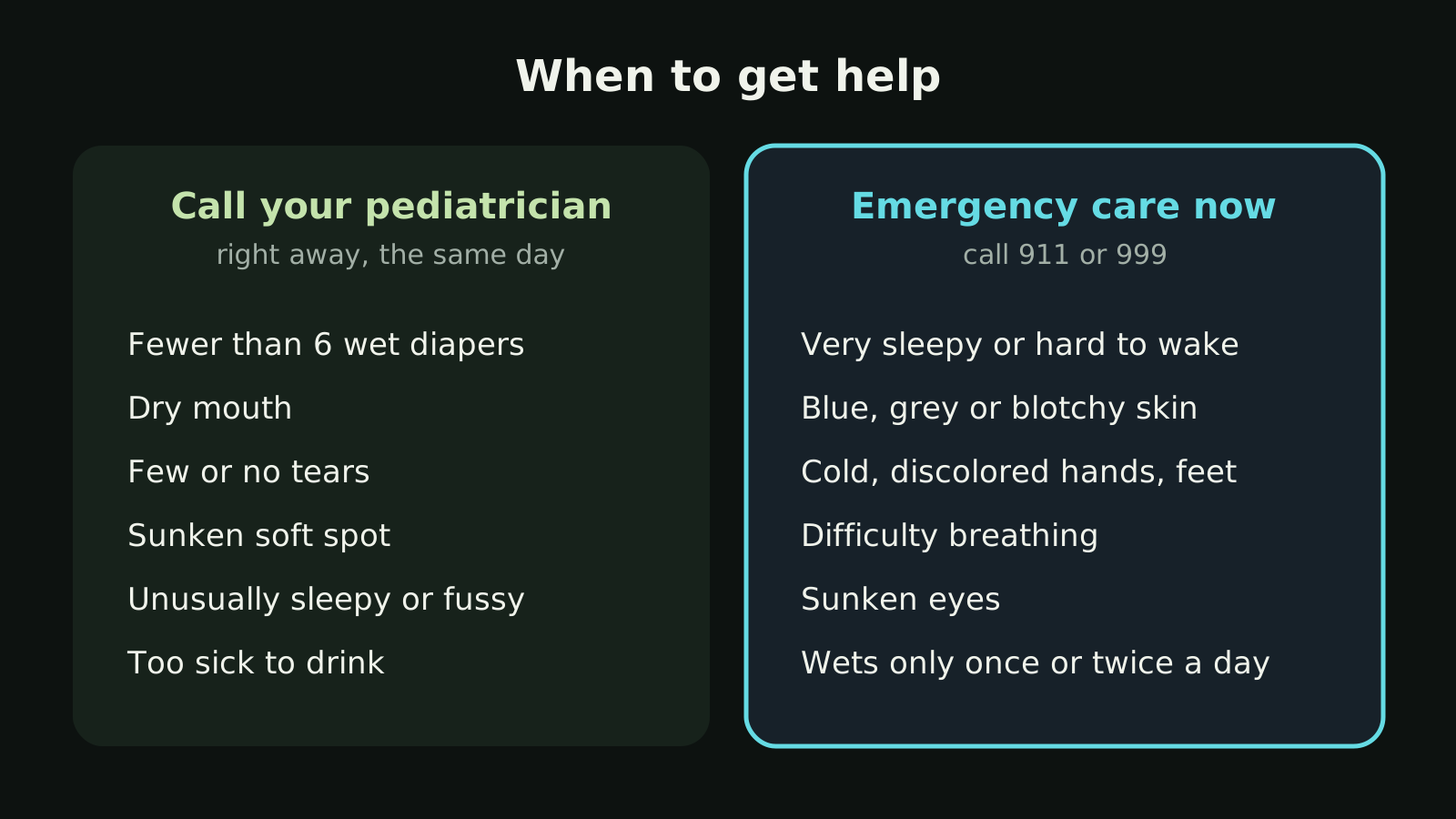
Call your pediatrician right away, the same day, if your baby:
- has fewer than 6 wet diapers in 24 hours, or clearly fewer than usual
- has a dry mouth or tongue, or cries with few or no tears
- has a sunken soft spot
- is unusually sleepy or fussy
- is too sick to drink, or seems lethargic
- is breathing quickly
The AAP’s advice for a vomiting child lists most of these as reasons to call the doctor right away. The NHS says to get an urgent appointment or call NHS 111 for a baby who is drowsy, has a sunken soft spot, has few or no tears, has fewer wet nappies, or is breathing fast or has a fast heartbeat.
Call 911 (999 in the UK) or go to the emergency department now if your baby shows signs of severe dehydration, including the NHS emergency signs. That means your baby:
- is very sleepy, floppy or hard to wake
- has blue, grey, pale or blotchy skin, lips or tongue
- has cold hands and feet with discolored skin
- is having difficulty breathing
- has wet only once or twice in a day
The NHS advises not driving yourself to the hospital in an emergency. Ask someone else to drive, or call for an ambulance.
What can I do while I get advice?
Keep offering milk. The AAP says frequent breastfeeding alone often keeps babies hydrated, and that you can generally keep breastfeeding through diarrhea. The NHS says to keep breastfeeding or formula feeding and offer small amounts more often.
- Don’t dilute formula. The NHS says not to make it weaker.
- Don’t give juice or fizzy drinks. The AAP says babies under 1 shouldn’t have juice, and the NHS says sugary drinks can make diarrhea or vomiting worse.
- Ask before giving water or an oral rehydration solution. The AAP says babies under 6 months get all the fluid they need from breast milk or formula, and shouldn’t have extra water unless a pediatrician advises it. The AAP recommends electrolyte solution for milder dehydration following your pediatrician’s directions, and the NHS suggests asking a pharmacist which oral rehydration solution suits your baby.
- If your baby is vomiting, small amounts often may stay down better. For babies 6 months to 1 year, the AAP suggests small sips or sucks every few minutes of undiluted breast milk or formula, with a commercial oral rehydration solution if that isn’t tolerated, and says not to use water.
The AAP says signs of improvement include more activity, a better appetite and peeing more often.
How can tracking diapers help?
Counting wet diapers is one of the simplest ways to notice a change early, and it’s the first thing many pediatricians ask about. When a baby is unwell and you’re up through the night, it’s easy to lose count, especially if two people are doing changes. A shared note or a tracker such as Cradle lets everyone log changes and feeds in one place, so you can tell the doctor how many wet diapers there have been in the last 24 hours and when your baby last fed.
A record helps you describe what’s happening, but it can’t tell you whether your baby is dehydrated. If the signs above worry you, call without waiting for a full day of counts.
How can I lower the risk?
- Feed on demand, especially in the early weeks. Our guide to how often a newborn should eat explains the usual pattern.
- During illness, offer feeds more often. The AAP says not to withhold food for more than 24 hours.
- In hot weather, keep your baby out of direct sun and heat, which the NHS lists as a cause of dehydration, and dress them for the temperature. Our post on how to dress a baby for sleep covers overheating at night.
- Ask your pediatrician about the rotavirus vaccine. The CDC calls vaccination the best way to protect your child from rotavirus disease.
Sources
- Signs of Dehydration in Infants & Children (HealthyChildren.org, American Academy of Pediatrics)
- Treating Dehydration with Electrolyte Solution (HealthyChildren.org, American Academy of Pediatrics)
- Drinks to Prevent Dehydration When Your Child is Vomiting (HealthyChildren.org, American Academy of Pediatrics)
- Recommended Drinks for Children Age 5 & Younger (HealthyChildren.org, American Academy of Pediatrics)
- Dehydration (NHS)
- About Rotavirus (CDC)
This article is for general education and is not medical advice. Talk to your pediatrician about your baby's health.