How much formula does a baby need by age?
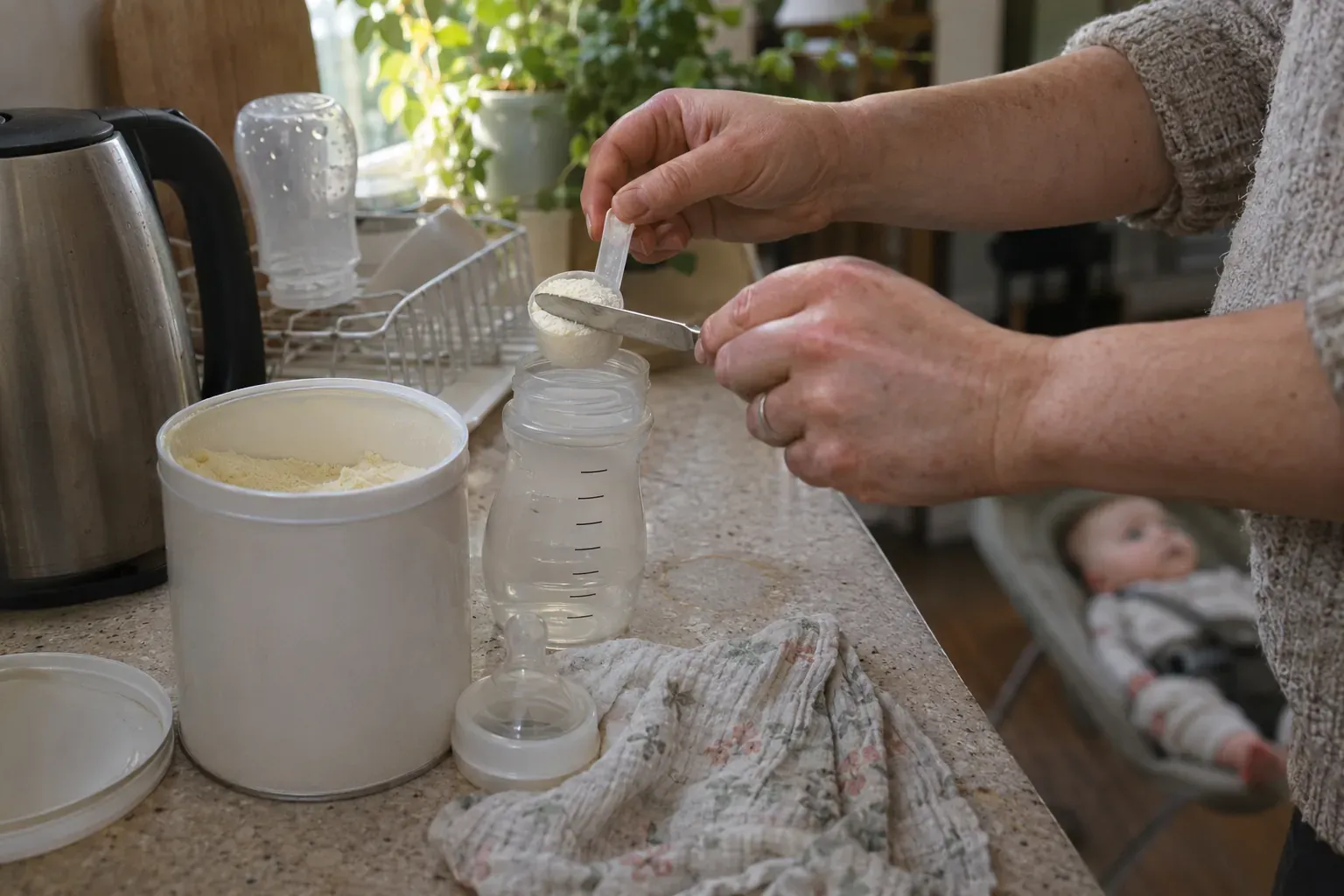
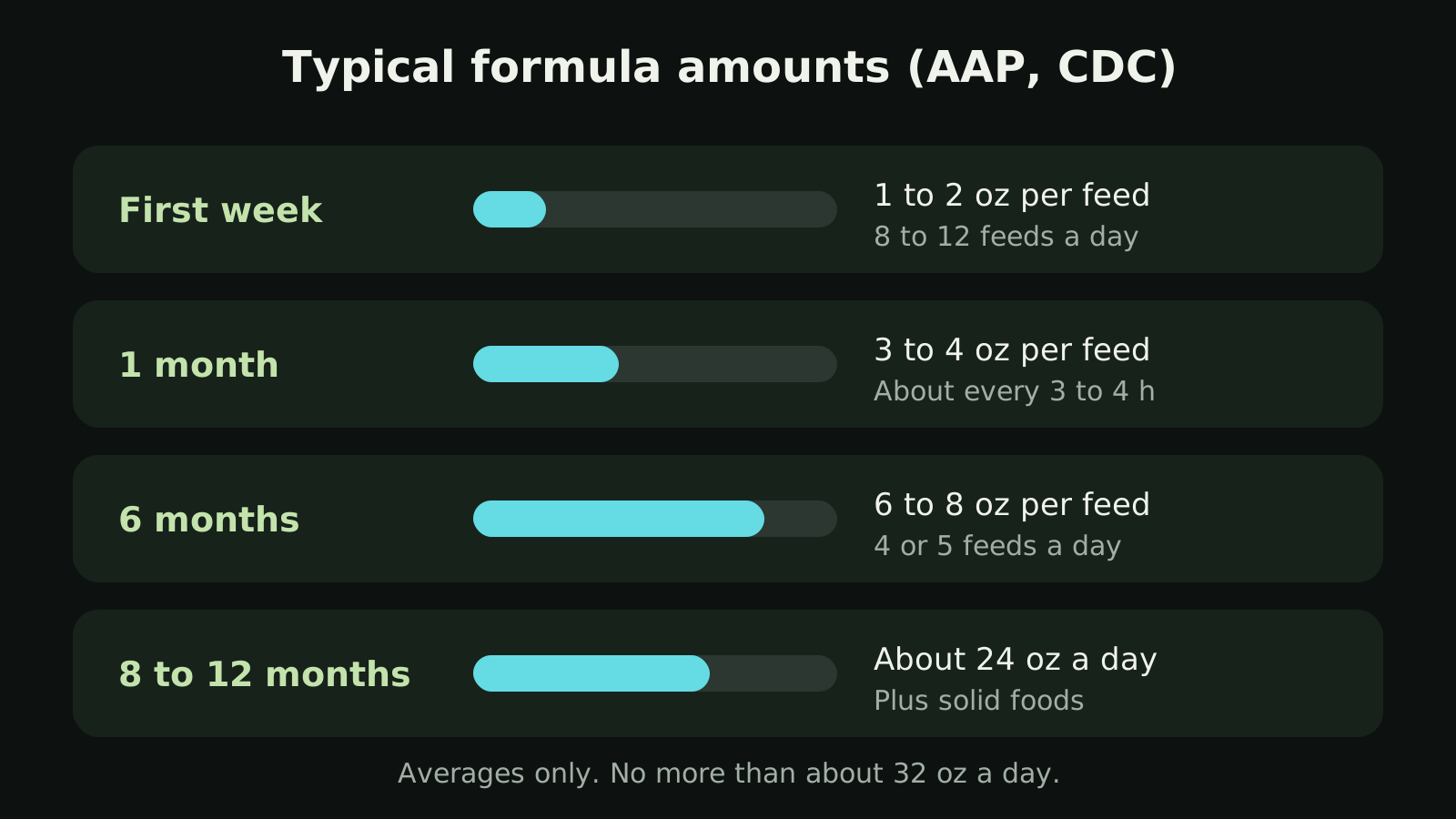
Most formula-fed babies take about 1 to 2 ounces (30 to 60 mL) per feed in the first week, 3 to 4 ounces (about 90 to 120 mL) by the end of the first month, and 6 to 8 ounces (180 to 240 mL) at each of 4 or 5 feeds by 6 months. The American Academy of Pediatrics (AAP) suggests a rough daily guide of about 2½ ounces (75 mL) per pound of body weight, and says babies generally shouldn’t average more than about 32 ounces (960 mL) in 24 hours. These are averages. The AAP, CDC and NHS all say to follow your baby’s hunger and fullness cues rather than a fixed amount, and never to push a baby to finish a bottle.
How much formula does a baby need at each age?
| Age | Typical amount per feed | How often | Source |
|---|---|---|---|
| First day or two | About half an ounce | Every 2 to 3 hours, at least 8 feeds a day | AAP |
| First days and first week | 1 to 2 ounces (30 to 60 mL) | Every 2 to 3 hours, 8 to 12 feeds a day | AAP, CDC |
| End of first month | 3 to 4 ounces (about 90 to 120 mL) | About every 3 to 4 hours | AAP |
| 2 to 4 months | No set figure; use the weight guide below | Most no longer need a night feed once over about 12 lb | AAP |
| 6 months | 6 to 8 ounces (180 to 240 mL) | 4 or 5 feeds in 24 hours | AAP |
| 6 to 12 months | Falls as solids increase | Formula or solids about 5 to 6 times a day | CDC |
| 8 to 12 months | About 24 ounces (720 mL) a day in total | Alongside meals | AAP sample menu |
In the first days, the CDC suggests starting with 1 to 2 ounces every 2 to 3 hours, and offering more if your baby shows hunger cues. As babies grow, they take more at each feed and go longer between them. The AAP says that by the end of the first month most babies take at least 3 to 4 ounces per feed on a fairly predictable schedule.
Between 2 and 4 months, the AAP says most babies who weigh more than 12 pounds (5.4 kg) no longer need a middle-of-the-night feed, and the gap between daytime feeds can occasionally stretch to 4 or 5 hours. It doesn’t give a separate per-feed amount for these months, which is where the weight guide is useful.
Solid foods usually start around 6 months, and the CDC says formula should gradually decrease as your baby eats more solids. The AAP’s sample menu for an 8 to 12 month old puts formula at roughly 24 ounces (720 mL) a day.
How do I work out formula by my baby’s weight?
The AAP’s rule of thumb is about 2½ ounces (75 mL) of formula a day for each pound (453 g) of body weight. A 10-pound baby, for example, would take roughly 25 ounces in 24 hours, spread across the day’s feeds.
Babies generally shouldn’t average more than about 32 ounces (960 mL) a day, and the AAP notes that babies often adjust how much they take from day to day. A small feed in the morning and a big one in the afternoon is normal. If your baby consistently wants much more or much less than these figures, talk to your pediatrician.
Should I feed on a schedule or follow my baby’s cues?
The AAP says newborns should be fed on demand, and a regular routine develops over time. The NHS says to offer a feed when your baby shows they want it, that babies often feed little and often, and that a big feed doesn’t necessarily mean a longer gap before the next one.
Early hunger cues include moving the head and mouth around, rooting, and sucking on fists or fingers. Crying is a late sign, so try to feed before it gets that far. Babies also suck for comfort, so not every suck or cry means hunger. Sometimes they need a cuddle or a diaper change. Our post on how often a newborn should eat covers hunger cues and feed timing in more detail.
There is one exception to waiting for cues. In the first few weeks, the AAP says that if your baby sleeps longer than 4 to 5 hours and starts missing feeds, you should wake them and offer a bottle.
How do I know my baby has had enough?
The CDC lists these signs that a baby under 5 months may be full:
- closing their mouth
- turning their head away from the bottle
- relaxing their hands
The NHS adds stopping sucking, pushing the bottle away and letting milk spill out. The AAP says a baby who gets fidgety or easily distracted during a feed is probably finished, while a baby who empties the bottle and keeps smacking their lips may still be hungry.
Don’t push your baby to finish. The NHS says forcing a baby to finish a feed is distressing and can lead to overfeeding, because “your baby will know how much milk they need.” The CDC agrees that a child does not need to finish a bottle. The AAP suggests offering a little less, since you can always give more. Bottle-fed babies are more likely than breastfed babies to overfeed, and the AAP lists stomach pain, gas, spitting up and vomiting as possible signs.
To let your baby set the pace, the NHS suggests holding the bottle nearly horizontal, only slightly tipped, so milk doesn’t flow too fast, and pausing for short breaks during the feed. Never prop a bottle and leave your baby alone with it, because of the risk of choking.
How can I tell my formula-fed baby is getting enough?
Wet diapers and weight gain are the signs to watch. The AAP looks for:
- 2 to 3 wet diapers a day in the first few days
- at least 5 to 6 wet diapers a day after the first 4 to 5 days
- steady growth within a healthy range on your pediatrician’s growth chart
The NHS gives a similar guide of around 6 wet nappies a day from a few days after birth. For more on what to expect, see how many wet diapers a newborn should have.
If you log bottles, the day’s total is more useful than any single feed. An app such as Cradle keeps bottles in the same timeline as sleep and diapers, which makes it easier to answer your pediatrician when they ask how much your baby takes in a day.
When can my baby stop having formula?
Around their first birthday. The CDC says that at 12 months you can switch from formula to plain, unsweetened, pasteurized whole cow’s milk or a fortified unsweetened dairy alternative, and that doing it gradually, replacing one formula feed at a time, can help. The NHS says to keep giving first infant formula until your baby is at least 1 year old, and that follow-on formula is not needed after 6 months.
The CDC says babies who drink about 32 ounces or more of formula a day don’t need extra vitamin D, while babies who drink less may. Ask your pediatrician whether your baby needs drops.
When should I call my pediatrician?
Talk to your pediatrician if:
- your baby seems to want to eat all the time, even when they seem full
- your baby consistently wants much more or much less than the averages above
- your baby is having trouble gaining weight
- you’re seeing fewer wet diapers than expected
- your baby often seems in pain, gassy or sick after feeds, or vomits
- your baby is very sleepy and missing feeds in the first weeks
- you have questions about vitamin D or switching to milk
Babies born early or with some medical conditions may need a scheduled feeding plan, which your pediatrician will set. And if anything about your baby’s feeding worries you, call.
Sources
- Amount and Schedule of Baby Formula Feedings (HealthyChildren.org, American Academy of Pediatrics)
- How Often and How Much Should Your Baby Eat? (HealthyChildren.org, American Academy of Pediatrics)
- Sample One Day Menu for an 8 to 12 Month Old (HealthyChildren.org, American Academy of Pediatrics)
- How Much and How Often to Feed Infant Formula (CDC)
- Signs Your Child Is Hungry or Full (CDC)
- Bottle feeding your baby (NHS Best Start in Life)
- Formula milk: common questions (NHS)
- Drinks and cups for babies and young children (NHS)
This article is for general education and is not medical advice. Talk to your pediatrician about your baby's health.