What is cluster feeding?

Cluster feeding is when a baby feeds several times close together, sometimes almost constantly with only short breaks, over a stretch of a few hours. The NHS describes it as a baby wanting to feed even more frequently than usual, sometimes constantly, for a period of time, and says it’s very normal and nothing to be concerned about. It can happen at any time of day but is more common in the evenings, and it’s most common in the first 3 to 4 months. On its own, it isn’t a sign that you’re not making enough milk.
What does cluster feeding look like?
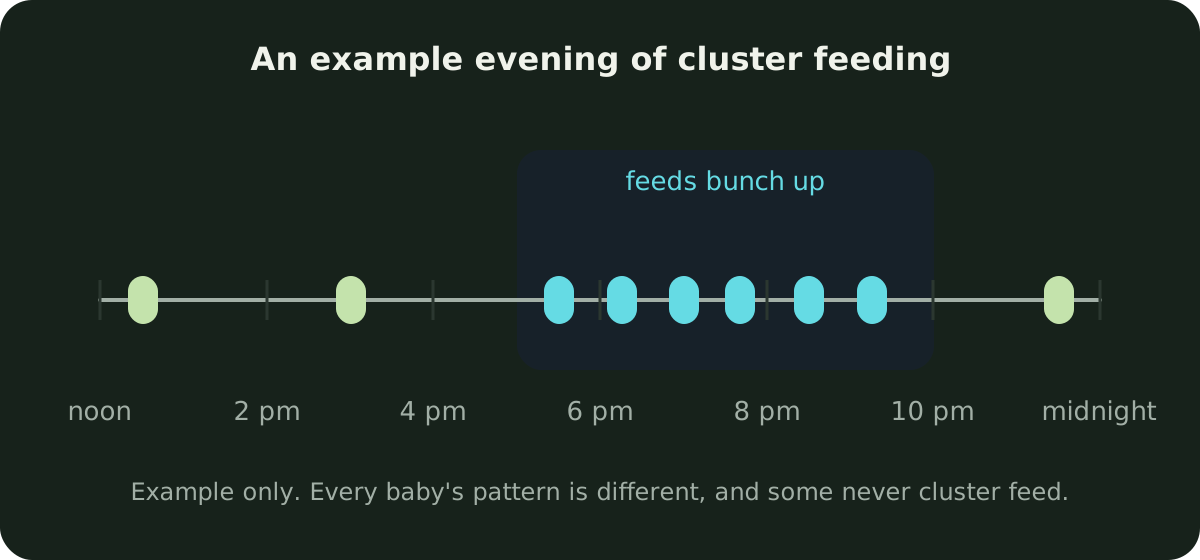
A typical day might have feeds spaced 2 to 4 hours apart, and then, from late afternoon or evening, your baby wants the breast or bottle every hour or less, feeds briefly, dozes, and wakes wanting more. The CDC says most exclusively breastfed babies feed every 2 to 4 hours on average, about 8 to 12 times in 24 hours, and that some babies may feed as often as every hour at times, which is often called cluster feeding. NHS Grampian describes babies feeding nearly constantly, with small breaks, and says it can happen at any time of day but is more common in the evenings.
The NHS says your baby may want to cluster feed during the day or night, or a bit of both. And it’s also completely normal for a baby not to cluster feed at all, according to NHS Grampian.
When is cluster feeding most common?
The NHS says cluster feeding usually happens during the first 3 to 4 months. It also says babies may cluster feed for a few days when they’re going through a growth spurt. NHS Grampian says growth spurts last a few days, and during one your baby may seem fussier and want to feed constantly.
You may see lists online giving exact growth spurt ages. Treat them loosely. A 2024 editorial in the journal Nutrients reviewed the research and found no evidence of fixed timing for growth spurts in the first year; the authors describe the published evidence as scarce. The practical point stands either way: a few days of much more frequent feeding is common and usually passes.
Why do babies cluster feed?
The sources describe what happens more than why. NHS Grampian says cluster feeding helps to establish your milk supply and aids bonding, and that during a growth spurt a baby who is growing fast needs your supply to match their demand, and feeding more often is the only way they can signal that. The Nutrients editorial makes a related point: when a healthy baby latches well, greater demand and longer sucking stimulate more milk production. None of the sources we read gives a proven reason for the evening timing in particular, and we won’t guess at one.
Does cluster feeding mean my milk supply is low?
Not by itself. NHS Grampian says it’s really important not to take frequent feeding as a sign on its own that you aren’t making enough milk. The Nutrients editorial notes that crying, fussiness and short gaps between feeds are commonly and hastily put down to low supply, and that this perception is a major reason parents start formula or stop breastfeeding earlier than they planned.
Look at the whole picture instead. NHS Grampian says breastfeeding is going well when your baby is gaining weight, has plenty of wet and dirty nappies, feeds comfortably and effectively, and becomes more content and alert between feeds. The AAP’s HealthyChildren.org gives numbers: by 5 to 7 days old, 6 or more wet diapers a day with pale urine, at least 3 to 4 yellow stools a day, nursing at least 8 to 12 times in 24 hours, and losing no more than 8 to 10 percent of birth weight in the first days before regaining it. Our post on how many wet diapers a newborn should have walks through the counts by day.
Feeding through a cluster is also how supply responds. The NHS says to feed your baby as often as they want and for as long as they want, and that you can’t overfeed a breastfed baby. If you’re worried, the NHS advises asking for help early from your midwife, health visitor or a breastfeeding specialist. In the US, that means your pediatrician or a lactation consultant.
Do formula-fed babies cluster feed?
They can. The NHS says you can cluster feed formula milk, but it’s important not to overfeed your baby. Watch for cues that your baby needs a break or has had enough. The NHS lists splaying fingers and toes, letting milk spill from the mouth, stopping sucking, turning the head away and pushing the bottle away. A baby who’s full may simply refuse the bottle or fall asleep at the end of the feed.
How do I cope with cluster feeding?
- Settle in. NHS Grampian suggests checking that your position and attachment are comfortable, keeping a table nearby with snacks and water, and asking your partner to keep you supplied.
- Hand off everything else. If someone else can take dinner, the dishes, an older child or the laundry, the evening gets easier.
- Plan for exhaustion. The AAP warns that the risk of sleep-related infant death is up to 67 times higher when a baby sleeps with someone on a couch, so a sofa or armchair is the wrong place to feed if you might doze off. If you bring your baby into your bed to feed or comfort them, the AAP says to place them back in their own sleep space before you go to sleep. If you think you might fall asleep, the AAP says to first remove pillows, blankets and anything else that could cover your baby’s face, head or neck, and to move your baby to their own sleep space as soon as you wake. For every sleep: on their back, on a firm, flat surface, in their own sleep space in your room, with no soft objects or loose bedding. Our post on the ABCs of safe sleep covers the full AAP guidance.
- Expect broken nights for a while. Cluster feeding can run into the night in the early weeks. Our post on how often newborns wake at night explains what’s typical.
Logging feeds for a week makes the pattern easier to see, and shows whether the rest of the day looks normal. Cradle: Baby Sleep Tracker by Zorest, for example, shows each feed on a daily timeline, and a partner or caregiver you invite can see the same record. Our post on how often a newborn should eat gives the daily totals to compare against.
When should I call my pediatrician?
Cluster feeding on its own isn’t a reason to call. These signs are. HealthyChildren.org lists warning signs of breastfeeding problems:
- after 7 days, fewer than 6 wet diapers and 4 stools a day, or urine that is dark yellow or flecked with red
- your baby is still under their birth weight at two weeks
- your baby still seems hungry after most feedings
- your baby doesn’t seem to be swallowing during feeds (call right away)
- a newborn who sleeps longer than 4 hours at night and is hard to wake for feeds
Also call if you see jaundice. HealthyChildren.org says to contact your pediatrician if your baby’s skin becomes more yellow, the yellow spreads to the abdomen, arms or legs, the whites of the eyes look yellow, or your baby is hard to wake, fussy or not nursing or taking formula well. The AAP also says that if you’re concerned your baby wants to eat all the time, even when they’re full, talk with your pediatrician.
If something feels wrong, call.
Sources
- Cluster feeding (NHS Best Start in Life)
- Cluster feeding and growth spurts (NHS Grampian, Birth in Grampian)
- How Much and How Often to Breastfeed (CDC)
- How Often and How Much Should Your Baby Eat? (HealthyChildren.org, American Academy of Pediatrics)
- How to Tell if Your Breastfed Baby is Getting Enough Milk (HealthyChildren.org)
- Warning Signs of Breastfeeding Problems (HealthyChildren.org)
- Jaundice in Newborns (HealthyChildren.org)
- How to Keep Your Sleeping Baby Safe: AAP Policy Explained (HealthyChildren.org)
- Breastfeeding: the first few days (NHS)
- Breastfeeding: is my baby getting enough milk? (NHS)
- Infant Growth Spurts in the Context of Perceived Insufficient Milk Supply (Nutrients, 2024, PMC)
This article is for general education and is not medical advice. Talk to your pediatrician about your baby's health.