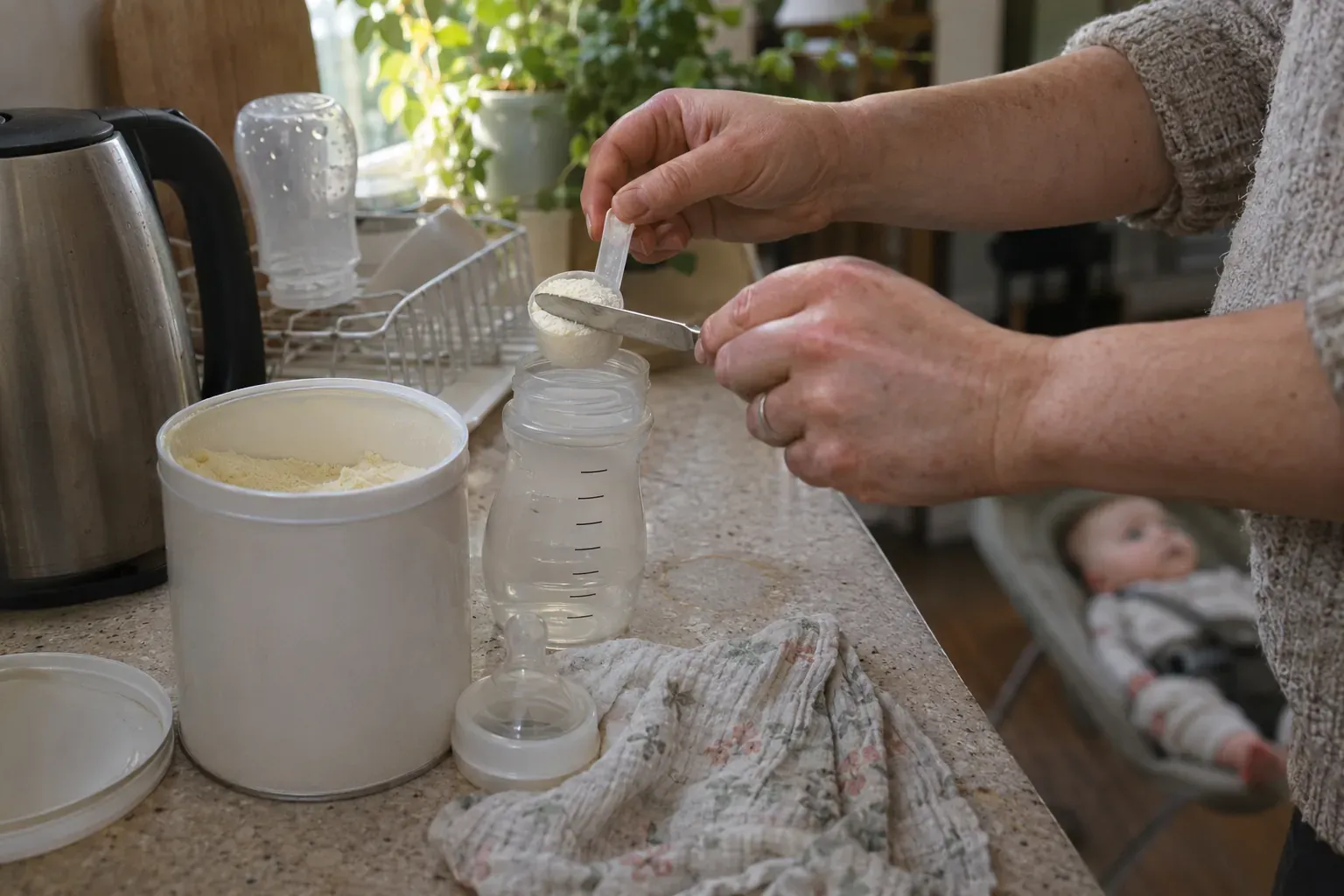
What is paced bottle feeding?
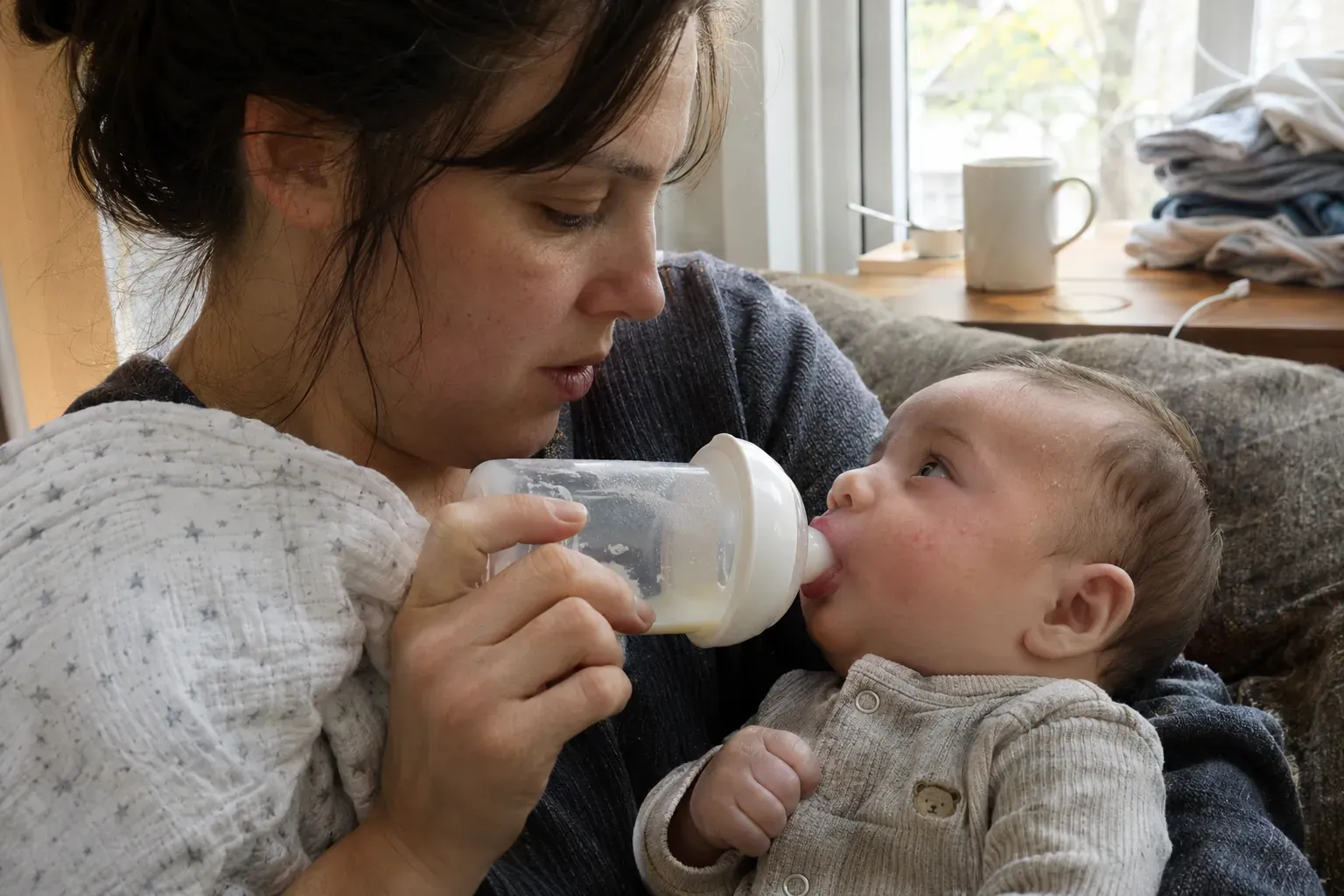
Paced bottle feeding is a way of giving a bottle that lets your baby control how fast and how much they drink. You hold your baby semi-upright, invite them to draw the teat into their mouth, keep the bottle almost horizontal so milk doesn’t pour, and lower or remove it whenever your baby pauses or shows they’ve had enough. The NHS describes paced feeding as a way of giving your baby more control over feeds, and it works with breast milk or formula.
Why is it called paced feeding?
Because your baby sets the pace. The NHS says babies usually take small amounts of milk, stop for a rest, and then take more. Held upright and tipped steeply, a bottle can keep milk flowing whether or not your baby is ready for it. Holding it nearly level means milk comes mainly when your baby sucks, which is also what the CDC advises: position the bottle at an angle rather than straight up and down, so milk only comes out when your baby sucks.
Paced feeding is part of what the NHS calls responsive feeding, which means feeding your baby when they show you they’re hungry rather than on a strict schedule. The NHS says feeding to hunger cues can reduce the risk of overfeeding.
How do I pace a bottle feed?

These steps come from the NHS, with details from the CDC and the American Academy of Pediatrics.
- Hold your baby close in a semi-upright position, so you can see their face. HealthyChildren.org suggests cradling your baby’s head in the crook of your arm. Don’t feed a baby lying flat on their back; the AAP says lying down increases the risk of choking.
- Let your baby take the teat. Gently rub the teat against your baby’s top lip and let them open their mouth and draw it in. When introducing a bottle to a breastfed baby, HealthyChildren.org says your baby should be allowed to explore the nipple with their mouth, not have it forced past their gums.
- Keep the bottle almost horizontal. The NHS says to keep it just slightly tipped to stop milk flowing too fast. HealthyChildren.org adds that milk should cover the nipple so your baby isn’t swallowing air, so tip it only as far as you need for that.
- Follow the pauses. When your baby stops sucking or shows they need a break, lower the bottle or gently remove the teat to stop the flow. The NHS says that if your baby gets upset when the teat comes out, you can tilt the bottle down with the teat still in their mouth. The CDC says to let your baby take breaks when they seem to want them.
- Stop when they’re done, even if there’s milk left. Wind your baby by holding them upright and gently rubbing or patting their back.
Paced feeds can take longer than you expect, so keep an eye on the clock for milk safety: the CDC says to use prepared formula within one hour of when feeding begins and throw away whatever your baby doesn’t finish. For breast milk, the CDC says to use leftovers within 2 hours of the end of the feed and then discard them.
What signs should I watch for?
Your baby’s cues tell you when to start, pause and stop. The CDC lists early hunger signs from birth to 5 months: hands to the mouth, turning toward the breast or bottle, puckering, smacking or licking the lips, and clenched hands. It notes that crying is often a late sign of hunger, so offering a feed before your baby is upset tends to go more smoothly.
During the feed, the NHS says signs that your baby needs a break or has had enough include splaying their fingers and toes, letting milk spill out of their mouth, stopping sucking, and turning their head away or pushing the bottle away. The CDC’s fullness signs are similar: closing the mouth, turning away, and relaxing the hands. HealthyChildren.org says a full baby will release the nipple, turn away, and often fall asleep.
The NHS is clear that you should never force your baby to finish a bottle, because it’s distressing and can mean your baby is overfed. The CDC agrees: stop when your baby shows they’re full, even if the bottle isn’t empty.
Who is paced feeding for?
Any baby who takes a bottle. The NHS describes responsive and paced feeding in its general bottle-feeding guidance, and the CDC’s bottle advice covers both breast milk and formula.
If you’re introducing a bottle to a breastfed baby, the same unhurried approach applies. HealthyChildren.org suggests having someone else offer it at first, starting with about half an ounce an hour or two after a regular feed, when your baby is alert but not frantic, and stopping if more than ten minutes pass without feeding.
It also helps when other people do some feeds. A partner, grandparent or childcare provider can follow the same steps, so your baby gets the same rhythm from everyone. The NHS adds that babies feel more secure when most feeds are given by parents or main caregivers, especially in the early weeks. If several of you share feeds, writing down the time and amount of each bottle keeps everyone on the same page. Cradle: Baby Sleep Tracker by Zorest, for example, keeps bottles in a shared timeline with sleep and diapers.
Does paced bottle feeding actually work?
The evidence is early. In a small 2025 study in Early Human Development, 29 mothers fed their full-term babies by breastfeeding, by typical bottle feeding and by paced bottle feeding. Paced feeds were longer and slower than typical bottle feeds, and the amount of milk babies took was not significantly different. Mothers were more sensitive to their baby’s cues during paced feeds only when the babies’ cues were harder to read. The authors call their findings preliminary evidence that paced feeding may support responsive feeding.
So paced feeding isn’t proven to change how much your baby drinks or how they grow. What the health bodies agree on is the principle behind it: let your baby lead, watch for cues, and don’t push them to finish.
What shouldn’t I do with a bottle?
- Don’t prop the bottle or leave your baby alone with it. The NHS warns they may choke on the milk, and the CDC says not to prop or leave the bottle in your baby’s mouth.
- Don’t feed your baby while they’re lying on their back.
- Don’t count ounces against a target. HealthyChildren.org says babies generally know how much food they need, and that if you follow their hunger cues they’ll tell you when they’re full.
If your baby dozes off at the end of a feed, put them down on their back, on a firm, flat surface in their own sleep space, as the AAP advises for every sleep. Our post on the ABCs of safe sleep covers the rest.
When should I call my pediatrician?
Paced feeding won’t fix a feeding problem. Talk to your pediatrician if:
- your baby still seems hungry after most feeds (HealthyChildren.org lists this as a reason for a weight check)
- your baby is breastfed and, after 7 days, has fewer than 6 wet diapers and 4 stools a day, or dark yellow urine (another HealthyChildren.org warning sign)
- your baby regularly takes more than 7 or 8 ounces at a feed, which HealthyChildren.org says to discuss with your doctor
- anything about feeds worries you; you don’t need a checklist to call
For how many feeds to expect in a day, see how often a newborn should eat. For evenings when your baby wants to feed again and again, see what cluster feeding is.
Sources
- Feeding on demand (NHS Best Start in Life)
- Bottle feeding your baby (NHS Best Start in Life)
- About Feeding From a Bottle (CDC)
- Signs Your Child Is Hungry or Full (CDC)
- Infant Formula Preparation and Storage (CDC)
- Breast Milk Storage and Preparation (CDC)
- Bottle Feeding Basics (HealthyChildren.org, American Academy of Pediatrics)
- Introducing the Bottle (HealthyChildren.org)
- Warning Signs of Breastfeeding Problems (HealthyChildren.org)
- How to Keep Your Sleeping Baby Safe: AAP Policy Explained (HealthyChildren.org)
- Does paced bottle-feeding improve the quality and outcome of bottle-feeding interactions? (Early Human Development, 2025)
This article is for general education and is not medical advice. Talk to your pediatrician about your baby's health.