Does teething wake babies at night?
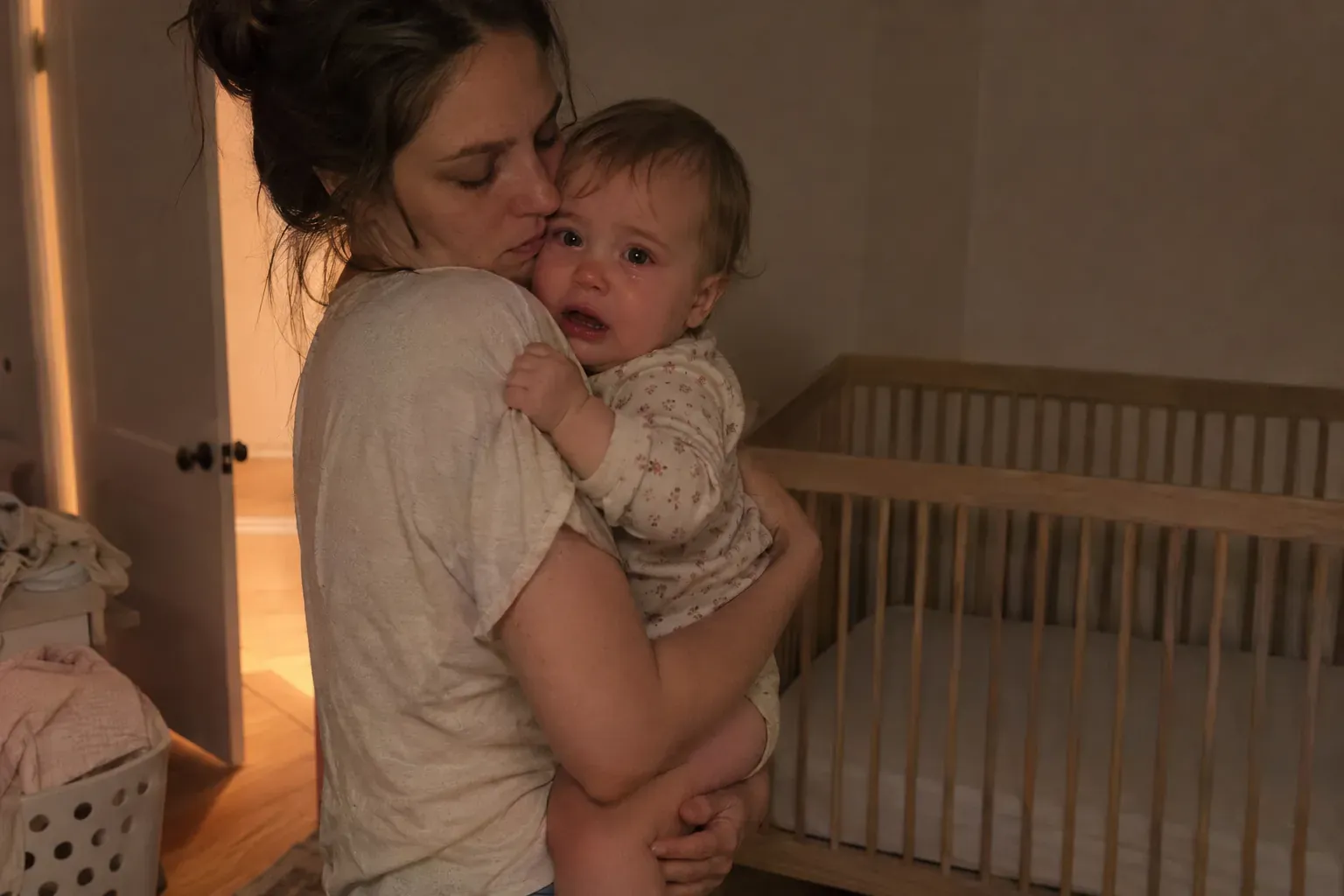
Teething can make some babies fussier and more wakeful for a few days around the time a tooth comes through, but the effect on night sleep looks smaller than many parents expect. In one large 2025 study that measured sleep with crib cameras, babies slept no differently on teething nights than on other nights, even though over half their parents reported disrupted sleep. If your baby is waking a lot, teething may be part of it, but it’s worth looking for other causes too, especially if there’s a fever.
When do babies start teething?
The American Academy of Pediatrics (AAP) says baby teeth usually appear between 6 and 10 months, though discomfort can start as early as 3 months. The NHS says most babies start teething at around 6 months, some before 4 months and some after 12.
The lower front teeth usually come first. The NHS describes a rough order: front teeth at about 6 months, the teeth beside them at about 8 months, first back teeth at about 12 months, canines at about 18 months and second back teeth at about 24 months. Most children have all their baby teeth by 2 to 3 years old. That means teething overlaps with a lot of other changes in sleep, which is part of why it’s hard to pin night wakings on it.
What does research say about teething and sleep?
The studies point in slightly different directions, and none of them shows teething keeping babies up for weeks.
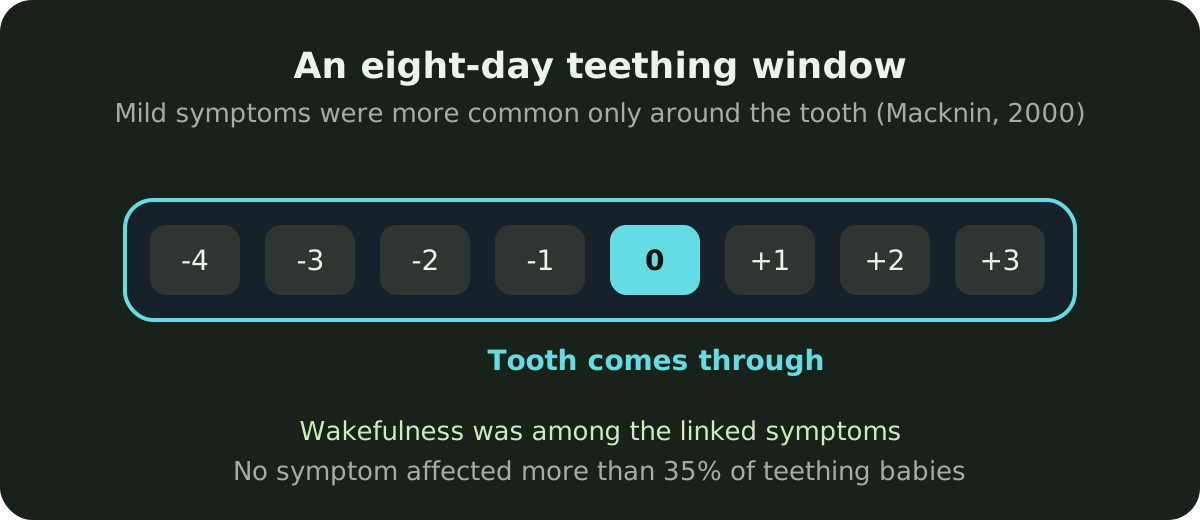
- Macknin and colleagues (Pediatrics, 2000) followed 125 babies from 4 months to 1 year, with parents recording 18 symptoms every day. Symptoms were only more common in an eight-day window: the 4 days before a tooth came through, the day itself and the 3 days after. Wakefulness was one of the symptoms linked to teething in that window, but “sleep disturbance” as a separate item was not. No symptom showed up in more than 35% of teething babies.
- Wake and colleagues (Pediatrics, 2000) followed 21 children aged 6 to 24 months in day care and did not find the expected strong links between new teeth and symptoms, including sleep. The authors said they couldn’t rule out weak links.
- Ramos-Jorge and colleagues (Pediatrics, 2011) examined 47 babies aged 5 to 15 months every day for eight months and did find sleep disturbance among the signs linked to teething, along with irritability, drooling, runny nose and loss of appetite.
- A 2016 meta-analysis in Pediatrics pooled 16 studies of children up to 36 months. About 70.5% of children had some sign or symptom while a tooth erupted. The most common were gum irritation, irritability and drooling.
- Kahn and colleagues (Journal of Pediatrics, 2025) used crib camera footage to measure sleep for four weeks in 849 babies aged 3 to 18 months. Total sleep, night wakings and parent visits to the crib were no different on teething nights. Three of the authors consult for the company that makes the cameras.
So teething may bring a few unsettled days and nights for some babies, close to when a tooth breaks through, but on this evidence it doesn’t explain a long run of broken nights by itself.
What are the signs of teething?
The AAP lists fussiness from swollen, tender gums, drooling, chewing on things and a rash around the mouth from drool. The NHS adds sore red gums, a slightly raised temperature, one flushed cheek, rubbing an ear, gnawing, more fretfulness and not sleeping very well. It also notes that some babies have no discomfort at all, or only mild symptoms for a few days.
What doesn’t teething cause?
Both the AAP and the NHS say some symptoms are often blamed on teething without good evidence.
- Fever. The AAP calls fever a false symptom of teething. The NHS lists a slightly raised temperature, below 38°C, as possible. A fever of 38°C (100.4°F) or more points to something else.
- Diarrhea. The AAP says teething does not change the way your baby’s gut works, and the NHS says there’s no evidence teething causes diarrhoea.
- Lots of extra crying. The AAP says teething discomfort is generally not severe enough to make a baby cry more than usual.
Macknin’s study made the same point: before putting signs of a possibly serious illness down to teething, other causes have to be ruled out.
How can I soothe a teething baby at night?
The AAP and NHS suggest simple comfort first:
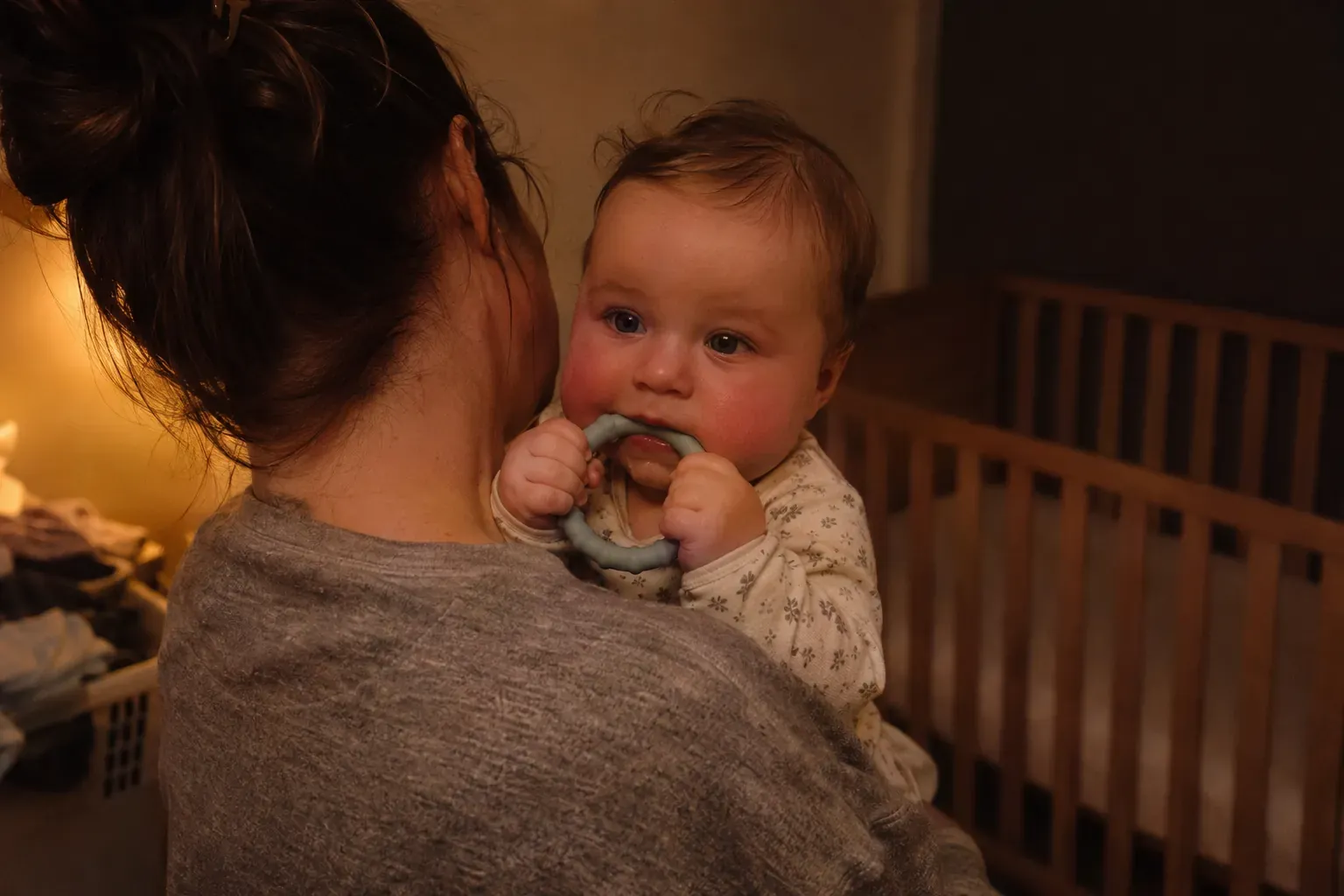
- A firm rubber teething ring or toy. The NHS says some can be cooled in the fridge, but never freeze a teething ring, as it can damage the gums. The AAP also says not to let your baby chew directly on anything frozen solid.
- A clean finger to rub the gums gently.
- A chilled, damp washcloth to chew on. The FDA advises staying with your baby while they use a teether, so they don’t choke.
- For bedtime, the AAP suggests a warm bath, a gentle massage and white noise kept at a low volume.
- Once your baby is eating solids, the NHS mentions chilled soft fruit, and says to avoid rusks and sugary foods, which can cause tooth decay.
Comfort your baby, then put them back down to sleep on their back on a firm, flat surface. Teething toys, washcloths and soft objects stay out of the crib; the AAP says soft objects and loose bedding in the sleep area raise the risk of suffocation. Our ABCs of safe sleep goes through the full setup.
If your baby seems very uncomfortable, the AAP suggests asking your pediatrician about acetaminophen. Check with them before giving your baby any medicine.
What should I avoid?
- Benzocaine gels, sprays and liquids. The FDA says benzocaine products should not be used for teething pain in children, because they can cause methemoglobinemia, a serious and sometimes fatal condition that lowers the oxygen in the blood. The AAP gives the same warning, and says numbing gels usually don’t help anyway.
- Lidocaine and homeopathic teething tablets or gels. The FDA says these offer little to no benefit and carry serious risks for teething children. The AAP warns especially about products with belladonna.
- Amber necklaces and other teething jewelry. The FDA has received reports of deaths and serious injuries, including strangulation and choking. The AAP says necklaces made of amber, wood, marble or silicone all carry these risks. The NHS adds: never tie a teething ring around your baby’s neck.
- Liquid-filled teething toys, which the AAP says can leak or tear.
- Alcohol, on the gums or otherwise.
Could something else be waking my baby?
Often, yes. The authors of the 2025 crib camera study suggested that pediatricians and parents look at other explanations for sleep problems before blaming teeth, and Macknin’s team said other causes must be ruled out before putting signs of illness down to teething. Babies wake at night for many reasons, and changes in how sleep is organized, such as the 4-month sleep regression, overlap with the months when teeth start to come through. Our post on how often babies wake at night covers what’s typical.
It can help to write down night wakings for a week or two, along with any new tooth you spot. If you log them in Cradle, the timeline shows whether wakings bunch up around the day a tooth appears or carry on regardless.
When should I call my pediatrician?
Call your pediatrician if:
- Your baby is under 3 months and has a rectal temperature of 100.4°F (38°C) or higher. The AAP says to call immediately, even if they seem otherwise well.
- Your baby is 3 to 6 months old with a temperature of 101°F (38.3°C) or higher, or older than 6 months with 103°F (39.4°C) or higher.
- They are crying more, and more often, than usual.
- They have diarrhea that lasts more than a day.
- They have any symptom that teething doesn’t usually cause, or anything that worries you. As the NHS puts it, you know your baby best.
If your baby has a seizure, tell your pediatrician promptly. The AAP says to call 911 if your baby has trouble breathing or a seizure lasts more than 15 minutes.
Sources
- Teething Pain Relief: How to Soothe Your Baby's Discomfort (HealthyChildren.org, American Academy of Pediatrics)
- Baby teething symptoms (NHS)
- Tips for helping your teething baby (NHS)
- Safely Soothing Teething Pain in Infants and Children (US Food and Drug Administration)
- Macknin ML et al. Symptoms associated with infant teething: a prospective study. Pediatrics, 2000
- Wake M et al. Teething and tooth eruption in infants: a cohort study. Pediatrics, 2000
- Ramos-Jorge J et al. Prospective longitudinal study of signs and symptoms associated with primary tooth eruption. Pediatrics, 2011
- Massignan C et al. Signs and symptoms of primary tooth eruption: a meta-analysis. Pediatrics, 2016
- Kahn M et al. Does teething disrupt infant sleep? A longitudinal auto-videosomnography study. Journal of Pediatrics, 2025
- Safe Sleep: 9 Ways to Reduce a Baby's Risk of SIDS and Suffocation (HealthyChildren.org, American Academy of Pediatrics)
- Fever and Your Baby (HealthyChildren.org, American Academy of Pediatrics)
This article is for general education and is not medical advice. Talk to your pediatrician about your baby's health.