What safe-sleep advice has changed since grandparents were parents?
Quite a lot has changed. If you raised babies before the mid-1990s, you were probably told to lay them on their tummy, tuck a blanket around them and pad the crib with bumpers. Today the advice is close to the opposite: on their back for every sleep, on a firm, flat mattress with nothing else in the crib, in the parents’ room but not in their bed. The change came from research in the 1990s showing that tummy sleeping raised the risk of sudden infant death syndrome (SIDS), and the National Institute of Child Health and Human Development (NICHD) is clear that earlier parents were doing their best with what was known at the time.
What has changed since the 1980s and 1990s?
Here is what the American Academy of Pediatrics (AAP) and NICHD say now.
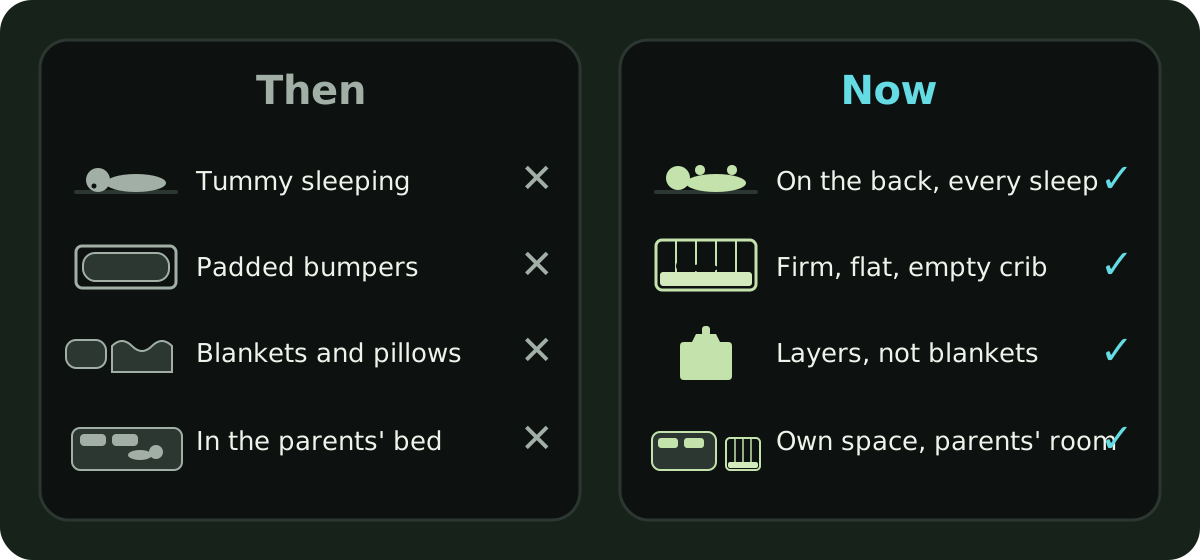
- Back, not tummy. NICHD’s campaign history records that the AAP first recommended back or side sleeping in 1992, NICHD launched the Back to Sleep campaign in 1994, and by 1996 the advice was to place babies wholly on their backs. The AAP now says side sleeping is as dangerous as tummy sleeping.
- Nothing in the crib. No bumpers, pillows, quilts, loose blankets or soft toys. The AAP explains that bumpers were once thought to stop arms and legs getting caught between the rails, but safety regulations now require narrow rail spacing. In 2022 the Safe Sleep for Babies Act banned crib bumpers and inclined sleepers in the United States.
- A firm, flat surface. The AAP says any surface that inclines more than 10 degrees is not safe for sleep. Car seats, strollers, swings and carriers are not for routine sleep; if your baby dozes off in one, move them to the crib. We cover that in car seat and stroller naps.
- Room-sharing, not bed-sharing. The AAP recommends the baby’s own crib or bassinet in the parents’ room for at least the first 6 months, and says room-sharing can lower the risk of SIDS by as much as 50 percent. NICHD lists bed-sharing with a grandparent or other non-parent caregiver as a high-risk situation.
- No hats indoors, and no overheating. Both the AAP and the NHS say to take hats off once you are indoors. Dress the baby in one more layer than you would wear, and use a wearable blanket instead of a loose one. See how to dress a baby for sleep.
- A pacifier at sleep time is fine. The AAP says offering one at naps and bedtime lowers the risk of SIDS, even if it falls out; if breastfeeding, wait until feeding is going well.
- Swaddling stops when rolling starts. The AAP says to stop as soon as the baby shows any sign of trying to roll, usually around 3 to 4 months. NICHD notes some babies start as early as 2 months.
- Drop-side cribs are no longer sold. A federal crib standard that took effect in June 2011 ended the sale of traditional drop-side cribs. The CPSC linked drop-side cribs with detaching rails to at least 32 infant deaths since 2000. The AAP says a crib made before June 2011 will not meet today’s standards, so replace one kept in the attic rather than reuse it.
- No weighted sleep products. The AAP’s 2022 update says weighted swaddles, weighted blankets and weighted clothing are not safe and not recommended.
Why did the advice change?
Because the research caught up. NICHD explains that babies on their stomach are more likely to overheat and to rebreathe the air they just exhaled, which raises carbon dioxide and lowers oxygen, and that it can change how the heart and lungs are controlled. Back sleeping carries none of those risks.
The old worry was choking. NICHD and the AAP both say there is no evidence that babies choke more on their backs. On their back, the windpipe sits above the food pipe, so spit-up has to work against gravity to reach the airway.
The AAP says the annual rate of sudden unexpected infant death has fallen by more than half since it began recommending back sleeping in 1992. At the same time, accidental suffocation deaths went up, so the advice grew to cover bedding, surfaces and bed-sharing, and NICHD renamed its campaign Safe to Sleep in 2012. The AAP still counts around 3,500 sleep-related infant deaths a year in the United States, about the same each year since 2000, so its 2022 update, the first since 2016, keeps the message plain: alone, on the back, in a bare crib or bassinet.
What hasn’t changed?
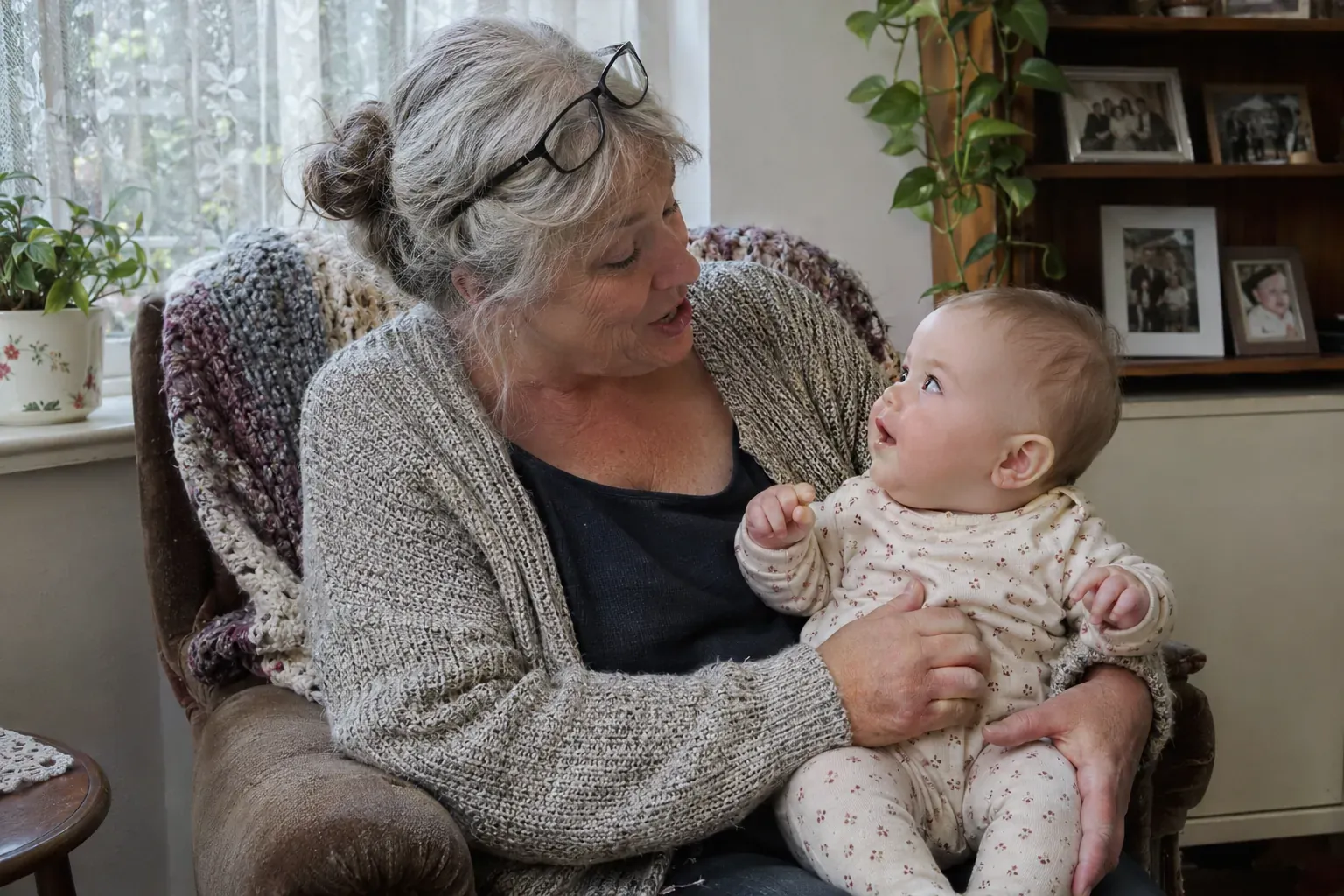
A baby still needs a calm, consistent caregiver who notices them, feeds them and holds them when they are awake. The AAP’s advice to grandparents who provide child care puts it well: “times have changed, although caring love is still the universal and timeless ingredient.”
Tummy time is still part of the day, as long as the baby is awake and someone is watching. The AAP says to start soon after coming home and build up to 15 to 30 minutes a day by 7 weeks.
Breastfeeding where possible, a smoke-free home and car, and keeping up with checkups and vaccinations still matter, and the AAP lists each as lowering the risk of SIDS.
How do I share the rules without a fight?
NICHD’s video for grandparents models the conversation. It says to explain the reasons rather than hand over a list, to accept that it has been a long time since they had a baby, and to expect some doubt at first. A few things that help:
- Show them the page. The AAP’s policy explainer, or a handout from your pediatrician, takes you out of the argument. The AAP asks parents to share its safe-sleep steps with grandparents and offers a pledge sheet caregivers can sign.
- Write the rules down. A card on the wall by the crib with four lines, back, nothing in the crib, sleep sack, no hat, is easier to follow at 2am than a conversation.
- Agree before the first babysit. Walk through the sleep space together and show the empty crib.
- Give them the same picture you have. A shared log shows a grandparent the last feed and the last sleep without texting you. Cradle: Baby Sleep Tracker by Zorest lets a parent invite a caregiver to the baby’s log so they can see and record care, and the parent’s subscription covers invited caregivers. Here is how to invite one.
What should I tell a grandparent before they babysit?
A short checklist you can print or text:
- On their back for every sleep, naps included, until their first birthday.
- Only in the crib or bassinet we showed you: firm flat mattress, fitted sheet only.
- Nothing else goes in: no blanket, pillow, bumper or toy. If the room feels cold, use the sleep sack.
- No hat indoors. To check their temperature, feel their chest or the back of the neck, as the NHS suggests.
- If they fall asleep in the car seat, the swing or your arms, move them to the crib.
- The pacifier is fine. If they start to roll, no more swaddling.
- Never doze off with them on a sofa or armchair. If you feel sleepy, put them down first.
- No smoking around them, indoors or out.
- Here is the pediatrician’s number, and here is ours.
Our ABCs of safe sleep post covers the same ground in more detail.
When should I call my pediatrician?
Ask about safe sleep at any checkup, especially if your baby was born early, has reflux or a medical condition, or if you are unsure whether a crib, bassinet or sleep product is safe. The AAP says babies with reflux should still sleep flat on their backs, but your pediatrician can confirm what is right for your baby.
Call emergency services straight away if your baby stops breathing, cannot be woken, is struggling to breathe, has a fit, has pale, blue or grey lips or skin, or is limp and floppy. The NHS lists these as reasons to call for help at once.
Sources
- How to Keep Your Sleeping Baby Safe: AAP Policy Explained (HealthyChildren.org, American Academy of Pediatrics)
- Safe Sleep: 9 Ways to Reduce a Baby's Risk of SIDS and Suffocation (HealthyChildren.org, American Academy of Pediatrics)
- Where We Stand: Back To Sleep (HealthyChildren.org, American Academy of Pediatrics)
- Safe Sleep: Back is Best, Avoid Soft Bedding, Inclined Surfaces and Bed Sharing (HealthyChildren.org, American Academy of Pediatrics)
- Baby Products to Avoid: Unsafe Registry Picks and Secondhand Gear (HealthyChildren.org, American Academy of Pediatrics)
- Childproofing Tips for Grandparents (HealthyChildren.org, American Academy of Pediatrics)
- Tips for Grandparents Who Provide Child Care (HealthyChildren.org, American Academy of Pediatrics)
- Ways to Reduce Baby's Risk (NICHD Safe to Sleep)
- About Back Sleeping (NICHD Safe to Sleep)
- Campaign History (NICHD Safe to Sleep)
- Safe Infant Sleep for Grandparents and Other Trusted Caregivers, video text alternative (NICHD Safe to Sleep)
- Safer Cribs for Babies Available Starting Today (CPSC, June 2011)
- Safe Sleep: Cribs and Infant Products (CPSC)
- Sudden infant death syndrome (SIDS) (NHS)
This article is for general education and is not medical advice. Talk to your pediatrician about your baby's health.